Choosing a good wetsuit for kids: essential criteria
The first contact with the ocean has an impact on future progress in any board sport. What makes the difference here is not looks, but maintaining constant thermal comfort. A suitable wetsuit for kids allows the experience to focus on fun, not on feeling cold.
In practice, the absolute priority is to ensure effective protection that extends time in the water. If there is only one takeaway, it’s this: a child who doesn’t lose heat can stay out longer, move better and learn more easily.
Types of kids’ wetsuits by water temperature
The criterion that determines the choice of model is the temperature of the water in which the activity will take place. Mundo-Surf offers options designed to cover everything from first dips to surf initiation. One thing to keep in mind when comparing formats: not all are designed for the same use or the same temperature range.
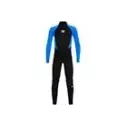
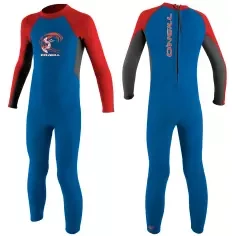
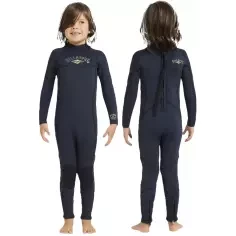
- Full surf wetsuits (long sleeve and full length legs): suitable for cold water or long sessions. Protection covers the entire body, retains heat better and adds a physical barrier against rubbing from the board or sand.
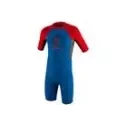
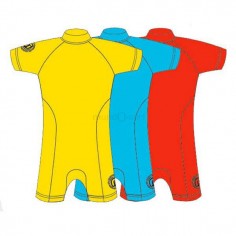
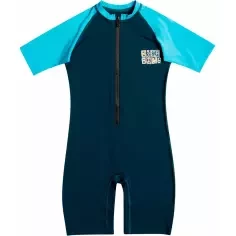
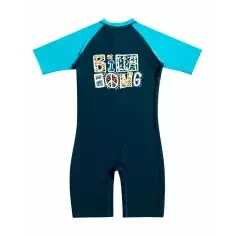
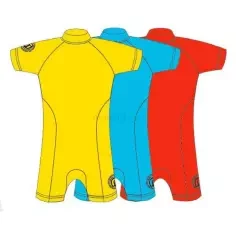
- Shorty wetsuits: more suitable for midsummer or mild waters. They offer greater freedom in the shoulders and knees and are usually easier to put on at younger ages.
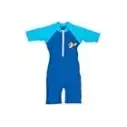
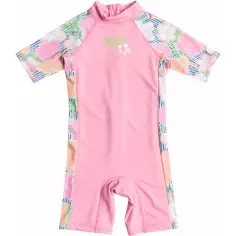
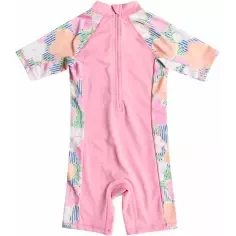
- Kids’ lycra options: useful when the priority is sun protection with very light thermal contribution. They work well at the beach, pool, shoreline and in situations where the child is constantly alternating between water and sand.
Wetsuit thickness: adapting protection to the child
The thickness of the material is the most useful indicator to gauge the level of warmth. In practice, 3/2 mm usually offers a good balance between warmth and flexibility for much of spring, cool summer days and early autumn. For high summer or mild waters, 2/2 mm or 2 mm is sufficient in many areas.
As a rough guide: below 17–18 °C, a full 4/3 mm starts to make sense even for short sessions. Between 19 and 22 °C, the deciding factor is usually between a shorty and a thin 3/2 mm, depending on exposure time and the child’s sensitivity to cold. Above 22–23 °C, a rashguard or a light wetsuit can cover the main need.
The differences between boards in these conditions become secondary if the body does not maintain its core temperature. A suit that is too thin limits useful time in the water; one that is too thick can reduce mobility and make the session feel heavier.
Comfort, fit and zipper
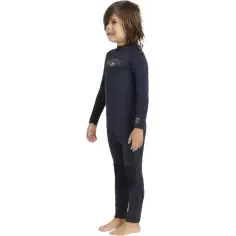
A wetsuit should fit like a second skin, with no air pockets or pronounced folds. What really matters here is that the neoprene is snug at the back, armpits, waist and behind the knees, but without excessive compression. If the child can move their shoulders and squat down normally, the fit is on the right track.
A chest zipper or chest zip improves water tightness and usually offers more freedom of movement. In smaller sizes, the back zipper is still a very practical option to make changing before and after the water easier. The factor that determines the choice at this point is not technical but functional: the child’s independence versus ease of putting the suit on.
One thing to keep in mind when checking the size: height and weight matter more than the age shown on the label. If it’s loose in the lower back or crotch area, it will lose thermal efficiency. If it is excessively tight at the neck and shoulders, it will compromise comfort from the very first minutes.