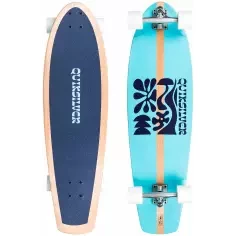
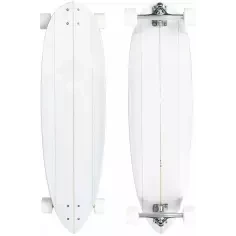
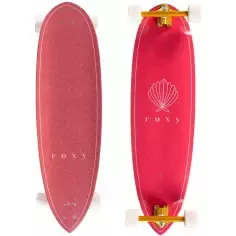
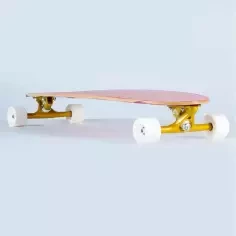
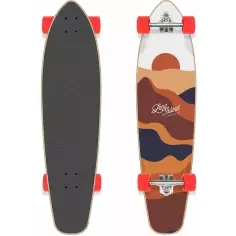
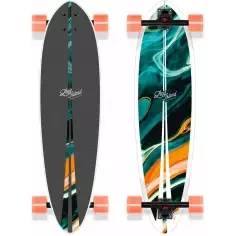
In a complete longboard, what really makes the difference is the consistency between deck, trucks and wheels. It’s not about adding the most expensive parts, but about making sure every component is designed for the same use: a cruising longboard doesn’t ride the same way as one for carving or freestyle. All the ready‑to‑ride models we’ve gathered here come from the best brands, with the guarantee that the setup is functional from the very first session.
Criteria for choosing a complete longboard
The first question is: what will be the main use? A 36" longboard gives good stability when cruising, but you lose maneuverability if you’re looking for quick turns. A 33" model responds better for carving but sacrifices float over long distances. For beginners, I recommend a size between 34" and 38", which offers control without compromising stability.
Deck size: length and control
The size of the longboard is measured in inches. A longer skateboard (36"–40") provides stability and float; a shorter one (31"–34") sacrifices those attributes in favor of agility. More specifically, the wheelbase — the distance between trucks — is what defines the turning radius and stability at speed. For relaxed cruising, choose a wheelbase over 20"; for aggressive carving, bring it down to 18"–19".
Deck: flex and grip
The flex of the deck depends on the material and thickness. A longboard with medium flex (between 2 and 4 on a stiffness scale) absorbs vibrations when cruising and responds well in wide turns. A stiff model is suitable for downhill or freeride, where every micro‑movement counts. As for the top of the deck, make sure the grip tape offers enough traction: worn‑out grip completely changes how safe you feel on the board.
Key components: trucks and wheels
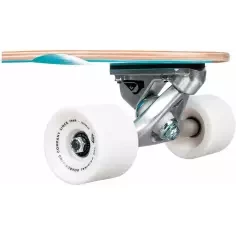
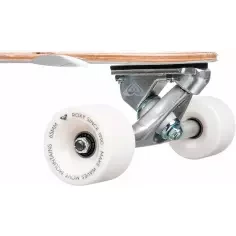
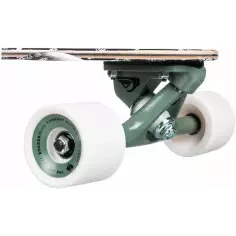
The trucks are critical. A high truck (180 mm–215 mm) makes it easier to perform wide turns and is recommended for cruising and freestyle; a low truck (140 mm–170 mm) reduces rocker and favors speed on descents. Truck hardness also matters: a soft truck gives in on turns but absorbs impacts, while a hard truck transmits every movement and demands more precision. Wheels are chosen by diameter and hardness. For slow cruising and stability, 60 mm–65 mm wheels with soft hardness (78A–85A) float better over cracks; for fast carving, 56 mm–60 mm wheels with medium hardness (87A–93A) deliver more precise response.
Bearings determine the speed and smoothness of the board. An ABEC‑7 rating is enough for most uses; ABEC‑9 is unnecessary for cruising, but useful if you’re aiming for precise downhill or freeride.
Skate styles: choose your use
Cruising: relaxed rides, stability and comfort. Longer deck (36"–40"), high trucks, soft, larger‑diameter wheels. It’s best to prioritize deck flex and smooth‑rolling bearings.
Carving: aggressive turns, flowing style. Deck with medium flex, mid‑to‑high trucks (180 mm–200 mm), 58 mm–62 mm wheels with medium hardness. On the water, this translates into control being the key factor.
Freestyle: tricks, dancing, maneuvers. Shorter deck (31"–35"), low‑to‑mid trucks, small (54 mm–58 mm), hard wheels. It takes practice, but allows for greater technical expression.
Freeride: moderate speed with turns and slides. Medium‑size stiff deck (34"–37"), mid trucks, 58 mm–62 mm wheels with medium‑to‑high hardness.
Downhill: fast descents, stability at high speed. Fully stiff deck, low trucks (170 mm–180 mm), hard 60 mm–65 mm wheels. One thing to keep in mind: this style requires proper protection and prior experience.
Why choose our complete longboards
Every complete longboard from Mundo‑Surf starts from one premise: components that work together, not just thrown together. Our stance at Mundo‑Surf is to check every setup, adjust the trucks, check the bearings and ensure that the deck, trucks and wheels match the same riding style. We have real stock in our own 1,000 m² warehouse in Seville, which means the longboard you receive is the one we have in front of us, assembled and ready to ride.