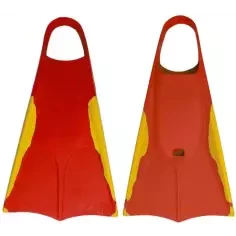
Symmetrical bodyboard fins are made up of two identical fins, which can be used on either the left or right foot. They are frequently used for drop knee, bodysurfing, and water rescue. Although they are less common in bodyboarding than asymmetrical fins, they still have a clear role in specific styles.
When should you choose symmetrical bodyboard fins?
Symmetrical fins are especially useful for riders who practice several disciplines or want gear that is easy to manage. If there is one key point, it’s this: you don’t need to distinguish between right and left foot, which makes position changes during the session easier. In practice, a single pair can cover different uses without added complications.
They are a reasonable option for beginners who are still defining how they want to surf. They also work well for water rescue professionals, bodysurfers, and drop knee riders who prioritize comfort and ease of use. The deciding factor here is versatility rather than the pursuit of maximum propulsion in prone.
Guide to symmetrical bodyboard fins: uses and features
What are symmetrical fins used for in bodyboarding and bodysurfing?
They are often used for drop knee because they tend to be shorter fins, which makes it easier to get onto your knees on the bodyboard. Their compact size makes quick weight shifts easier and improves control in that style. They can also be used in prone, although they are not usually the first choice when you are looking for maximum drive.
In bodysurfing, they offer enough propulsion without restricting leg movement as much. In water rescue, the ability to use either fin on either foot simplifies preparation and response. This is worth considering when you want multipurpose gear: this type of fin performs well in several real-world scenarios.
What are symmetrical bodyboard fins like? Features and differences
As the name suggests, these are bodyboard fins that are identical for the left and right foot. There is no specific fin for each side, unlike asymmetrical fins. That simplifies both how you use them and how you handle them day to day.
The factors that differentiate one board from another don’t apply here; what sets one fin apart from another is its stiffness, its length and the type of rubber used. In symmetrical models, the blade is usually more compact, which is useful for drop knee and also for swimming where you want to keep good freedom of movement. The key choice is usually between a soft blade for comfort and a medium blade for more responsiveness.
In practice, sizing needs to be precise, especially if you’re going to wear booties. In mild water, between 18 and 22 °C, many people use the fin directly on the foot or with a thin sock; below 17 °C, 2 to 3 mm booties are common. Keep this in mind when comparing sizes: fins that are too loose cause chafing and loss of control, while fins that are too tight restrict circulation.
In terms of performance and comfort, what really makes the difference here is how easy they are to use across several disciplines. A single pair lets you swim, kick for propulsion and change position with fewer constraints. If your main use will be intensive prone riding, it’s worth also comparing asymmetrical fins; if you want an all-round option, symmetrical fins make clear sense.