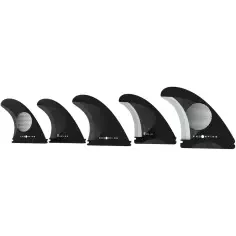
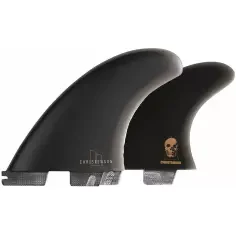
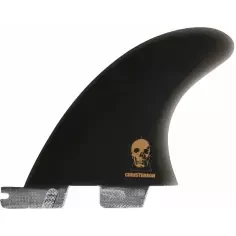
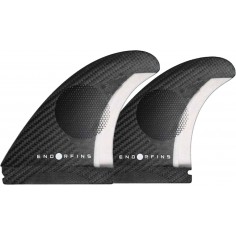
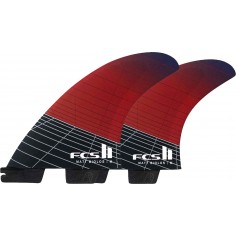
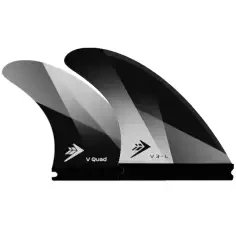
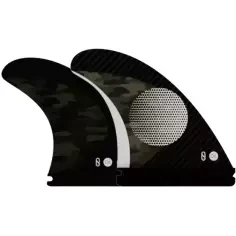
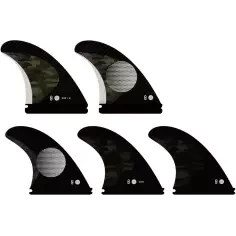
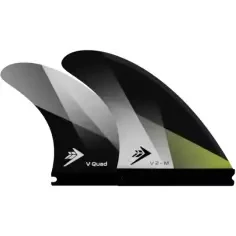
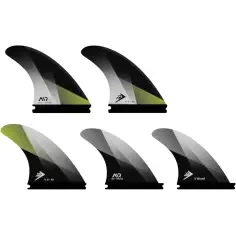
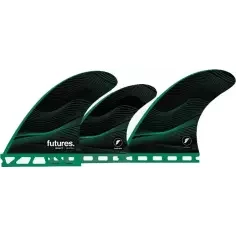
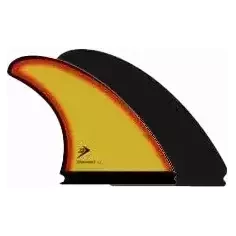
Tri-quad surf fins are made up of 5 fins: 4 side fins to set up the board in a quad configuration and 1 center fin to use it as a thruster together with the 2 main side fins. If your surfboard is compatible with quad and thruster, this setup lets you have both configurations in a single fin set.
Quad setup: speed and release through turns
The quad setup adds speed and lateral response in turns. The 4 fins, with the 2 smaller ones placed at the back, create a board with more drive and acceleration. In practice, the quad works best when you:
- Surf small waves and need to generate speed by yourself
- Want sharper turns and a livelier response in maneuvers
- Prefer a looser, more reactive board under your feet
- Are starting to work on maneuvers and want more freedom of movement
Thruster setup: control and stability
The thruster setup uses the larger center fin together with the 2 main side fins. This configuration offers control and stability along the line. The usual criteria for choosing it are:
- You surf more powerful waves and need drive and instant response
- You prefer a more predictable board when engaging the rail and changing direction
- You’re looking for more hold in wider turns without losing your line
- Your technical level is intermediate or advanced
What changes between quad and thruster
What sets one board apart from another in these conditions isn’t just the number of fins, but how the board distributes pressure and support. The quad frees up the tail and slightly reduces drag: it usually works well in weaker waves or from knee to chest high. The thruster adds a central pivot point, which is useful when the waves get bigger, from chest to overhead, or when your turns need to stay more controlled.
If you had to boil it down to one idea, it would be this: quad to prioritize speed and flow; thruster to prioritize control and a clearer read of the board. On hybrid boards or modern fish shapes, that difference is especially noticeable. On shortboards more geared towards powerful beach breaks, the logic usually leans more towards the thruster.
Fin system: Futures and compatibility
The key factor here is the fin system. Many tri-quad sets use Futures, although there are also versions in FCS or equivalent systems. When choosing, make sure: check that your board’s fin boxes match the system of the fin set exactly.
It’s also worth checking fin size according to your weight and level. As a useful reference: size S for under 65 kg, M for 65–80 kg, L for 75–90 kg, with variations depending on the stiffness you want and the volume of the board. On Mundo-Surf, the filters by size, fin system and materials help you narrow down your choice with a more practical approach.