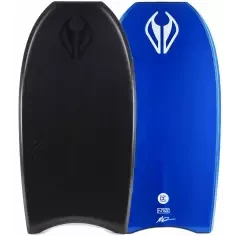
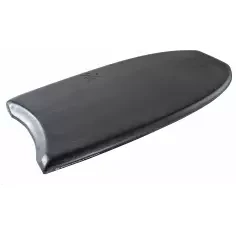
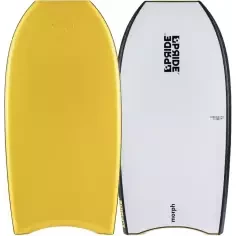
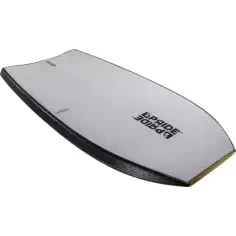
Drop knee bodyboards are designed for a very specific way of riding within bodyboarding: surfing with one knee resting on the bodyboard. This stance requires a different volume distribution than a prone board. What sets one board apart from another in these conditions is, above all, the combination of a narrower nose, a tail with solid support, and a firm construction.
In practice, the narrower nose helps generate speed and maintain a cleaner line. The crescent tail provides grip and control through turns, especially when the wave demands strong rail engagement. Things to keep in mind when choosing this type of board: overall stiffness and rail definition directly affect precision and dynamic stability.
There are specific drop knee models and other hybrid ones that allow you to switch between drop knee and lying prone position. The deciding factor is how you really use it. If you mostly ride in drop knee, a dedicated model usually performs better; if you want to alternate stances, a hybrid offers a more versatile platform.
Drop knee bodyboards: technical features and knee position
What makes a drop knee bodyboard different for the knee position?
Drop knee bodyboards are designed to surf with one knee on the board and the other leg extended for support. That’s why they’re usually stiffer and concentrate usable volume better towards the back. If there’s one key point: they need to respond well to an asymmetric load from the body.
The nose is reduced compared to a prone board, while the tail plays a bigger role in supporting the stance and maintaining control through the line. This outline helps you accelerate without the board breaking down under the pressure of the knee. In small and medium waves, between 0.5 and 1.5 m, this difference is especially noticeable coming out of turns.
The internal construction also plays a clear role: a central stringer adds stiffness and limits lateral torsion. The rail is usually more defined to make quick direction changes easier. In practice, what really makes the difference here is the immediate response when you shift your weight to the tail or to the inside rail.
What is the main difference between drop knee and prone?
The main difference lies in the stance and how your body loads the board. In drop knee, one knee stays on the board and your weight is concentrated further back; in prone, your body is lying down and distributes pressure more evenly. That base completely changes the type of shape that works best.
Drop knee boards usually feature a more compact nose, a tail with more support, and more stable behavior when you’re on the rail. A prone board, on the other hand, prioritizes front-end float and paddling comfort while lying down. What sets one board apart from another in these conditions is its ability to hold speed without losing control when your weight isn’t centered.
The deciding criteria are straightforward: main stance, type of wave, and skill level. For riders who mostly surf small or medium waves and want quick turns, a specialized drop knee board makes sense. For mixed use or for riders who are still defining their style, a hybrid usually fits better.
What materials and construction should a drop knee board have?
The construction of a drop knee bodyboard has a direct impact on stiffness, control, and durability. Cores can vary, but for this style it’s important to have a solid base that doesn’t easily deform under the weight of the knee. When comparing materials, keep in mind: it’s not just about strength, but about how the board rebounds and returns the pressure from each weight shift.
A central fiberglass or carbon stringer adds more stiffness and is usually ideal for intermediate to advanced riders, or for those weighing more than 75–80 kg. A slightly more flexible construction can feel more forgiving for beginners or in softer waves. In practice, the more powerful the wave or the more technical the maneuver, the more useful that extra stiffness becomes.
The rails also change how the board rides. A sharper rail offers more bite and precision in technical turns; a softer rail is less demanding and more forgiving. What really matters here is the balance between control and ease of use, in line with the rider’s actual level.
Thickness and volume must be assessed along with the rider’s weight. As a rough guideline, a lighter rider may feel comfortable on thinner, more responsive boards, while a heavier rider will need more support in the tail and more overall volume. If there’s one key takeaway, it’s better to prioritize a board that keeps solid support under the back foot area rather than just chasing low weight.