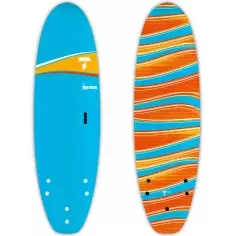
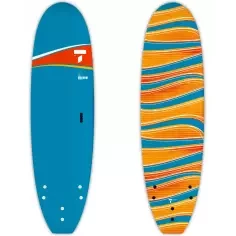
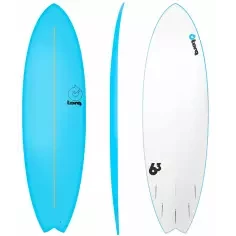
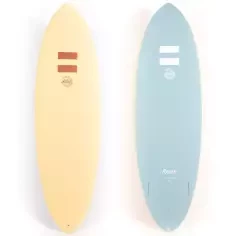
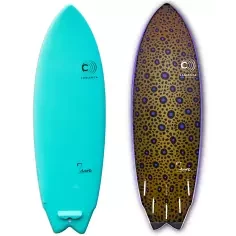
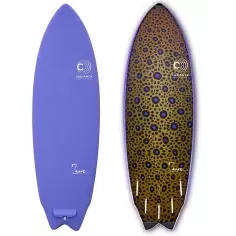
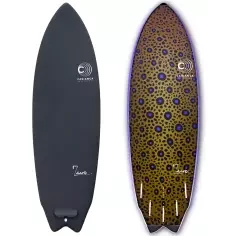
Soft top surfboards are surfboards with a rigid core, laminated in fiberglass and epoxy resin, and finished with a top layer of PE or EVA foam. They sit halfway between a rigid surfboard and a traditional softboard. What makes the difference here is the combination of stiffness, durability and a deck that is safer on impact.
In practice, the key factor when choosing between a classic softboard and a soft top mainly depends on your level and the type of progression you are aiming for. If the goal is to gain control and keep an extra margin of safety, the soft top usually fits better. If, on the other hand, you prioritise a very forgiving board for your first sessions, the softboard still makes sense.
Buying guide: how to choose a soft top surfboard according to your surf level
How to identify a soft top surfboard: differences compared to a softboard
At first glance, a soft top can look very similar to a softboard. They share a soft polyethylene or EVA deck and, in photos, the difference is not always obvious. In practice, when you touch it you can feel a firmer base under the soft layer.
The reason is simple: the soft top starts from a stiffer construction, like a laminated board, and adds a soft surface on the top. A traditional softboard is usually more uniform in flex and softer overall. What sets one board apart from the other in these conditions is the response under your feet, especially when turning and paddling.
What soft top surfboard volume you need
Volume determines buoyancy, stability and paddling ease. For soft top boards, you normally move between 35 and 65 litres, although the longer models can exceed that figure. If there is only one key takeaway, it would be this: to start with, it is better to prioritise litres over manoeuvrability.
As a useful reference, a beginner is usually around their weight in kilos plus 10 to 15 extra litres. For example: 70 kg translates into an approximate range of 80 to 85 litres for a very comfortable start, although in more compact soft top formats this ratio can be lower if you already have some technical base. Something to keep in mind when comparing one board to another: it is not only the total litres that matter, but also how that volume is distributed between width, thickness and length.
Soft top or softboard: which option fits better depending on use
The soft top offers more stiffness and a more precise rail feel than a classic softboard. It keeps the soft deck, but gives sensations closer to those of a hard board. In practice, this helps you progress faster in using the rails, in your take off and in your first wide turns.
The traditional softboard is still a solid choice for surf schools, first whitewater waves and surfers looking for maximum forgiveness. The soft top, on the other hand, makes more sense for consolidated beginners and lower-intermediate levels, especially in small to medium waves of 0.5 to 1.5 metres. The deciding factor is the balance between pure safety and the capacity for technical progression.
Advantages of a soft top surfboard for learning and progressing
The foam deck reduces the risk from bumps and falls. Underneath, the rigid structure improves the board’s overall response. What makes the difference here is that this combination lets you learn with a margin for error without giving up cleaner sensations under your feet.
They also tend to offer a more consistent useful life than many basic softboards, as long as construction and maintenance are correct. Something to bear in mind when you are looking for a board for several years: a well-chosen soft top can work to get you started, to consolidate your paddling and to remain useful when the conditions get a bit more demanding. If there is only one key takeaway, it is that the soft top stands out for allowing a more natural progression from the beginner stage to more demanding recreational surfing.