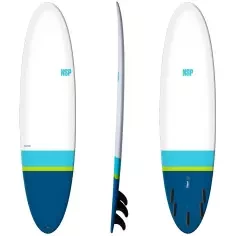
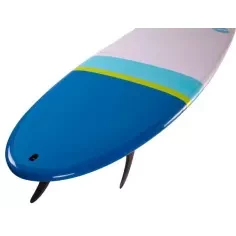
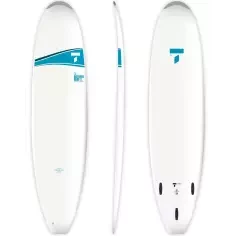
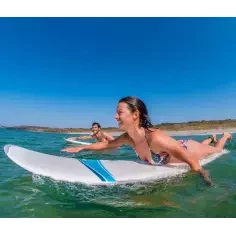
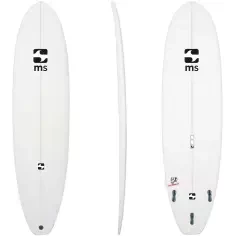
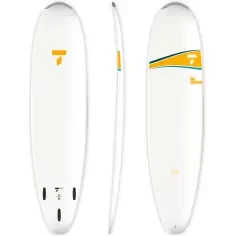
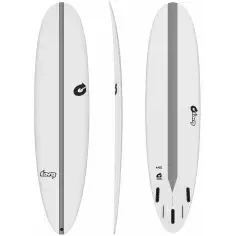
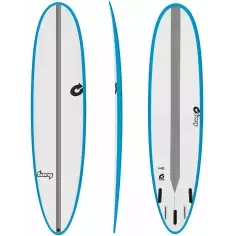
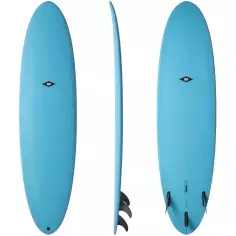
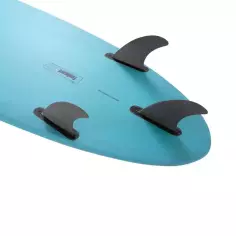
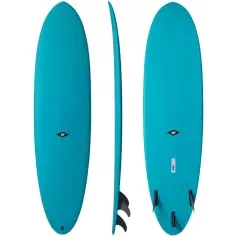
If you’re looking for an entry-level surfboard with maximum ease of use, the key criterion here is volume: a mini-malibu provides the buoyancy you need to paddle with less effort and gain stability from your very first sessions. In practice, this lets you focus on technique instead of trying to compensate for a board that’s too demanding. What really makes the difference is matching dimensions, liters and construction to your actual weight and level.
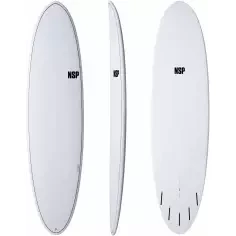
Mini-malibu surfboards are a particularly good fit for beginners who are heavier or have more limited fitness. They’re wide boards from tail to nose, conceptually close to evolution surfboards, but with a fuller nose. That wide base improves stability and makes paddling easier, two key points for progressing safely.
Mini-malibu surfboard guide for beginner and progressing surfers
What is a mini-malibu surfboard and how does it work?
A mini-malibu is a board with more volume and width than many evolution models, designed to make it easier to learn paddling, catching waves and popping up. What distinguishes one board from another in these conditions is how that volume is distributed: a wider nose and a stable platform are more forgiving of positioning mistakes. Typical lengths range from 6'0" to 7'6", with volumes usually between 40 and 60 liters depending on size and construction.
In practice, it works because it picks up speed earlier in small waves and holds its line better while your level is still basic. Compared to a shorter, narrower board, it demands less precision in every movement. If there’s just one takeaway, it’s this: a mini-malibu helps you catch more usable waves per session, and that speeds up real progression.
When should you use a mini-malibu: ideal levels and conditions
A mini-malibu usually makes sense once you’ve taken your first steps on a softboard surfboard, or when you want a stable board to start from zero with a bit more glide. It’s a great match for beginner and lower-intermediate levels, especially to work on take off, paddling position and your first turns. The deciding factor isn’t just your technical level: weight, mobility and how often you surf also play a role.
It performs particularly well in small to medium waves, from 0.5 to 1.5 meters, with a soft face and low power. One thing to keep in mind when the surf is more powerful or hollow: a high-volume board helps at the beginning, but can become less precise if your goal is to perform faster maneuvers. The same logic as with an evolution board: the easier the wave, the more you’ll get out of this kind of shape.
What advantages does a mini-malibu offer over other surfboards?
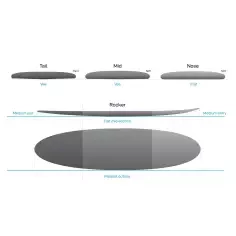
The main advantage is the extra volume: more buoyancy, more stability and more efficient paddling. This translates into easier take offs and greater tolerance for mistakes while popping up. What really matters here isn’t just length, but the relationship between width, thickness and how the liters are distributed.
Compared to an evolution surfboard, a mini-malibu usually offers an even more stable platform and easier wave entry. Compared to a longboard, it keeps some of that ease but with a more compact length and simpler handling both in and out of the water. If there’s just one takeaway, it’s this: the mini-malibu aims to balance learning, safety and basic maneuverability.
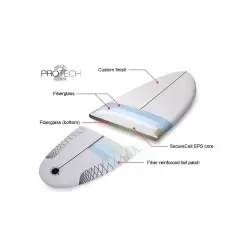
Construction also matters: an epoxy model is usually lighter and more responsive, while a softboard prioritizes forgiveness and safety in the early stages. In practice, the choice between the two depends on where you are in your progression. For an absolute first-time surfer, a softboard still makes a lot of sense; to bridge the gap between beginner and progressing surfer, epoxy usually offers more room to grow.
How to choose the size and volume of your mini-malibu
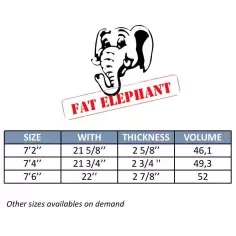
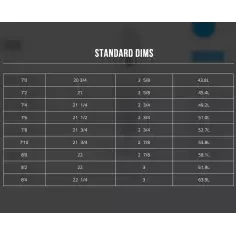
You can recognize a mini-malibu by its long, wide outline, with a generous nose and visible volume from nose to tail. What sets one board apart from another in these conditions is the useful volume for your weight, not just the length in feet. As a rough guideline, a beginner surfer weighing 60 to 70 kg will usually be comfortable between 45 and 50 liters; from 70 to 85 kg, between 50 and 55 liters; above 85 kg, it’s often best to look at 55 liters or more.
In terms of size, the most common range is between 6'6" and 7'6". A longer board makes paddling and catching waves easier; a slightly shorter one improves control once you already have some basic skills. One thing to keep in mind when comparing two similar models: an extra 2 or 3 liters can be more noticeable than a few inches of length.
If you’re a complete beginner, prioritize stability and paddling ease over maneuverability. If you’re already linking take offs and basic direction, you can go slightly shorter or drop a bit of volume to gain responsiveness. The deciding criterion here is simple: choose a board that helps you catch waves consistently today, not one that will only make sense several months from now.