Shopping Cart
There are no more items in your cart


Difference between surfboard shapes: a complete guide


The performance of a board on a wave is ultimately governed by its geometry. A subtle change in where the foam sits will radically alter its behavior on a steep drop compared to a weak section. I have seen many surfers hinder their own progress by using equipment designed for waves they never actually surf.
Main surfboard shapes and what they do
Analyzing what different surfboard shapes do involves a direct assessment of rocker, outline, and foam placement. A pronounced rocker pushes more water and creates a tighter turning radius, whereas a flatter profile builds and maintains speed in soft waves. These specifications must correspond to the conditions you surf daily, not an idealized version from a magazine.
The Firewire Dominator II Helium is a concrete example of how shifting the wide point back changes a board's drive. This particular outline results in a versatile surfboard shape that helps intermediate riders carry momentum through flat spots. In practice, these design elements define the trade-off between stability and maneuverability on every wave.

From longboard to shortboard: core shape categories
A proper examination of surfboard shapes explained requires understanding how distinct categories manage foam and curvature. Each one reallocates material to prioritize a specific type of performance in the water. Concretely, you are deciding between planing speed in weak waves and rail engagement in hollow surf.
- Longboard (8–12 ft): This design utilizes a round nose, minimal rocker, and high volume. It provides smooth turns and efficient paddling, allowing you to catch waves easily when the swell lacks power.
- Shortboard (under 7 ft): Characterized by a pointed nose, steep rocker, and thin rails. This shape is for the experienced surfer who demands total control in critical, steep sections.
- Fish surfboards (4'8''–6'2''): These combine a wide front end with a swallow tail to generate maximum speed on flat water. They perform best in small to medium waves, creating drive where other board shapes would stall.
- Funboard / hybrid (6'6''–9'): A transitional shape that merges stability with responsive turns. I would select this for a surfer looking to improve their core technique without losing their wave count.
Grasping these geometries is essential if you plan to build a custom board. The extensive range of surfboard shaping kits we stock covers all these primary profiles. The position we hold at Mundo-Surf.com is to provide the precise templates that define these types of surfboard, giving shapers control over every dimension.
Specialised surfboard shapes for specific conditions
When wave heights become extreme, standard board shapes quickly become a liability. Guns exceed ten feet in length, using a narrow outline and a drawn-out pin tail to handle a true big wave environment. Their design completely sacrifices loose turns to maintain absolute control and hold at high speeds.
In contrast, grovelers conceal extra volume within a short, wide frame to prevent stalling in slow summer surf. Step-up boards offer a middle ground, bridging the gap between a daily driver and a dedicated gun. They match the speed of more powerful waves without sacrificing your paddling efficiency.
Why surfboard shapes matter for your surfing
Every curve on your board directly changes how you connect with the wave. Sufficient volume determines if you glide into waves or tire yourself out paddling. The width of your tail governs how the board releases water off the top of the wave.
Similarly, the shape of the nose decides if your rail will catch in a hollow section or slide across a flat one. Selecting a board for its look instead of its function will actively slow your technical development. You will see immediate gains once your equipment matches the actual conditions of your home break.
How surfboard nose, tail and design affect performance
The rocker measurement defines how a board fits into the wave face. These board shapes rely on measurable variables to govern their behavior in the water. You will notice that length, width, and volume never operate independently from the chosen fin setup or the rail profile.

Nose and tail shapes: how each design influences your ride
A round nose pushes more water and increases early lift, making it the defining feature of a traditional longboard. Conversely, a pointed, narrow nose removes foam from the front third of the board to prevent pearling in steep sections. The standard measurement for nose width is taken twelve inches down from the tip to accurately compare paddling efficiency.
The tail controls water release and directly dictates the sensation of your turns. The squash tail remains the most common tail shape across modern shortboards because it balances responsiveness with hold. In practice, a round tail enables smoother arcs, while a swallow tail actively increases planing speed across flat sections.
A narrow pintail secures hold on a big wave, prioritizing control over maneuverability. A square tail, conversely, maximizes drive in slower conditions by extending the planing surface at the back of the board.
| Tail shape | Water release | Best conditions | Turn feel |
| Squash tail | Fast and controlled | Small to medium waves | Snappy, responsive |
| Round tail | Smooth and gradual | Medium to large open faces | Flowing, arcing |
| Swallow tail | High planing speed | Small, slow waves | Loose and fast |
| Pintail | Maximum hold | Big, powerful surf | Precise, locked-in |
| Square tail | Wide surface drive | Small, slow waves | Stable, skatey |
Rocker, volume and rails: the hidden performance variables
A comprehensive difference between surfboard shapes chart always contrasts rocker profiles against volume distribution. High rocker slows entry but allows for steep drops without catching the front rail. Flatter profiles generate superior drive in weak surf, which explains why fish and mid-length surfboard shapes carry minimal curve.
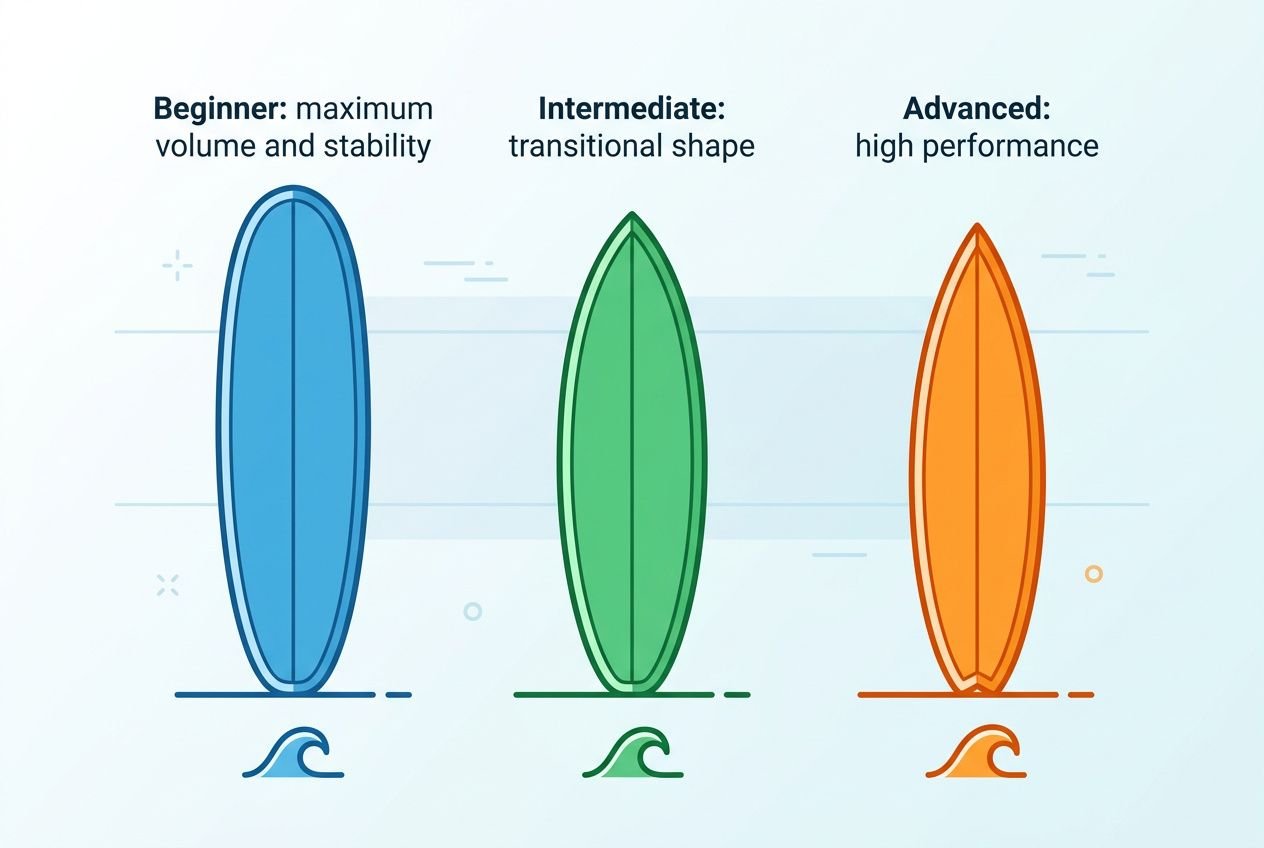
True volume determines buoyancy by multiplying the overall dimensions of your equipment. A beginner requires maximum foam to maintain stability and catch waves early. Dropping liters too quickly stalls progression, forcing you to paddle harder for fewer waves.
A soft rail creates forgiveness and maintains speed when navigating choppy surfaces. Hard edges bite firmly into the wave face to provide control during critical sections. Choosing the correct rail foil determines exactly where the board apex sits and how you link maneuvers together.
Fin configurations and their effect on surfboard shapes
Your chosen fin setup changes how a specific tail shape behaves under pressure. A single tail outline releases water completely differently when ridden as a thruster compared to a quad. You must match the box configuration to your target wave type before committing to a purchase.
- Single fin: This arrangement provides sustained down-the-line drive. You will experience deliberate, flowing arcs rather than quick pivots.
- Twin fin: A twin fin delivers a loose, fast glide for smaller surf. The drive comes directly from the rail line rather than a center fin.
- Thruster (three fins): This configuration balances speed with pivot. It remains the standard choice for most surfers globally.
- Quad fins: Quads generate rapid acceleration without the center drag. They excel in fast, open-faced conditions where hold is mandatory.
Understanding these variables makes choosing equipment a precise calculation rather than guesswork. When you select a shape from the 6,000-plus product catalogue at Mundo-Surf.com, you apply these exact principles. We stock configurations ranging from FCSII to standard US boxes in our 1,000 m² warehouse, ensuring your next board matches the Atlantic conditions you actually ride.
Recommended products

Best surfboard shapes for beginners and progression
The optimal surfboard shapes for beginners favor volume over maneuverability, dictating whether a session builds skill or frustration. A board that mismatches your true ability will actively hinder your learning pace. Concretely, initial progress requires stability and sufficient buoyancy to consistently catch waves, long before style becomes a concern.
Which surfboard shape suits a beginner best
The most suitable surfboard shape for a beginner typically falls into two categories: soft-top foam boards and longboards. Both designs maximize surface area to supply the forgiveness needed in your first seasons. What actually changes is the experience; you need a board that lets you pop up repeatedly without submerging.
- Soft-top foam board: Its high buoyancy and low danger profile establish it as the standard entry point. Modern iterations manage small waves excellently, delivering safety and dependable performance for initial sessions.
- Longboard (8–12 ft): This shape maximizes length and surface area to guarantee instant glide. It remains the easiest board for paddling into soft waves, making consistent wave-catching achievable.
- Mini-longboard (8–9 ft): A reduced version for a beginner surfer challenged by handling maximum foam. It preserves essential glide while staying manageable amongst other riders.
- Funboard (6'6"–9'): The logical selection for surfers with core mechanics seeking to initiate turns. It introduces mobility while upholding the necessary stability for progression.
Across all board shapes, a shortboard is wholly inappropriate for early learning. Its narrow outline and steep rocker demand advanced wave knowledge and precise paddling power. Choosing surfboard shapes from ambition rather than skill ensures stalled development.
Transitioning from longboard to shorter surfboard shapes
The funboard is the correct intermediate tool when moving down from maximum foam. Surfers who leap directly onto a shortboard sacrifice vital volume before cultivating the technique to drive it. A mid-length shape retains enough stability to confidently connect turns on the open face.
A fish outline offers an alternative step-down in softer, slower waves. Its wider profile sustains glide, while the twin fin configuration produces a unique, loose feel. In practice, adapting to this fin setup demands more precise weight placement than a standard funboard.
Our position at Mundo-Surf.com, informed by fifteen years of matching surfers to equipment, confirms that downsizing too early impedes growth. I would choose a forgiving shape until your wave count warrants a shift. To comprehend the mechanics behind these designs, the longboard shaping kit provides practical insight into foam distribution and rail configuration.
Surfboard shapes, sizes and materials compared
A polyurethane shortboard flexes entirely differently than an epoxy board cut to the exact same dimensions. The surfboard shapes you choose require a specific material to function correctly. Selecting a design without matching its construction ultimately compromises your session.
How construction materials change surfboard shapes'feel
The types of surfboard materials available today span five main categories with verifiable weight differences. I have learned that the construction method you choose matters as much as the foam inside, as each one alters performance.
- Soft-top foam: Buoyant and impact-forgiving. Advanced models hold a rail surprisingly well in small surf. I recommend matching this material with higher-volume board shapes for a beginner.
- Polyurethane (PU): The traditional standard. It offers natural flex and superior wave feedback. It remains easier to repair, though susceptible to pressure dents.
- Epoxy over EPS core: Lighter than standard polyurethane, which improves wave-catching momentum. It can feel stiffer in choppy water. I find it perfectly suited to performance shortboard designs.
- Helium construction: Used in the Firewire Dominator II. It combines a low-density EPS core with a parabolic rail made of balsa. This delivers a highly optimised weight-to-strength ratio.
Wooden boards generate distinct momentum through flat sections due to their high density. However, that same weight significantly limits dynamic maneuverability on steep wave faces. Concretely, your material choice must complement the types of surfboard shapes you ride.
Matching surfboard size to shape and rider profile
Surfboard shapes and sizes demand careful alignment with your specific body weight. A technically flawless outline paired with the wrong volume becomes unmanageable. An oversized longboard limits a lighter rider exactly like a shortboard sinks a heavier one.
The Firewire Dominator II scales across fifteen sizes, proving how adjusting length alters overall performance. At Mundo-Surf.com, our catalogue includes accurate size ranges across every major category. We maintain real warehouse stock and a 100-day return window to ensure your choice works.
Building your own surfboard to understand shape and materials
Shaping a blank remains the most effective method to understand how design variables interact. When you cut the rocker and set the fins yourself, theoretical concepts become practical realities. Designs that look identical on a screen behave entirely differently once glassed.
The types of surfboard shapes covered by the DIY kits at Mundo-Surf.com include everything from retro fishes to performance models. A complete kit provides a Teccel blank, Aerialite fiberglass, Hegardt resin, and a US box. Every variable sits entirely in your hands.
These board shapes represent serious templates for surfers who understand what they want underfoot. The pre-shaping service available through our workshop customises the blank to your precise measurements. This removes the most technically demanding cutting phase for those attempting their first build.
Frequently asked questions
What is the most common tail shape on modern surfboards?
In practice, the squash tail is the most common tail shape you will find on a modern shortboard. It provides a clean blend of a square outline with rounded corners. I would choose this design for its reliable hold and its capacity to generate speed out of your turns.
What surfboard shape should a beginner choose first?
The position we hold at Mundo-Surf.com is that a beginner must start on a soft-top or a longboard. These boards offer superior length and volume, which translates directly to increased stability and paddling power. This is critical, as the primary goal is to catch waves and build confidence; a smaller board will hinder that process entirely.
How do different fin setups change how a surfboard performs?
Your fin setup is a fundamental performance variable. A thruster offers balanced control for sharp turns, while a quad generates more speed with less drag. The difference comes down to feel: a twin fin setup, for instance, delivers a notably looser sensation from tail to nose, which changes how you approach each section of the wave.
Share this article: