Shopping Cart
There are no more items in your cart


Best surfboard for learning to surf: a beginner's guide


Picking the right surfboard for learning to surf is the decision that most affects how quickly you progress, how much fun you have and how safe you feel during those first sessions. This guide covers the factors that matter: size, volume, construction and specific board features. You can then choose a model suited to your weight, ability and local wave conditions without second-guessing yourself at the checkout.
Choosing a beginner surfboard with confidence
The difference between a board that supports your learning and one that slows you down is not always obvious in a photograph. Volume, width, outline and construction all matter, while Mundo-Surf carries a curated range built around these criteria.

What makes a board easy to surf
The best surfboard for learning to surf combines high flotation, a wide outline and a forgiving soft-top surface. That combination lets you focus on technique rather than worrying about impact or missing every wave. A board around 22 inches wide or more offers noticeably greater initial stability than a narrow performance shape, and you feel the difference from the first paddle out.
- Width A board measuring 22 inches or more gives your feet a stable platform during the pop-up and reduces the penalty for small weight-transfer errors.
- Outline A broad nose and tail keep the board predictable underfoot, leaving more room before a minor shift in balance becomes a fall.
- Soft deck An EVA or foam deck absorbs the impact of a wipeout and removes the need for wax, reducing preparation time and injury risk.
- Flexible fins Soft safety fins reduce the chance of injury to you and nearby surfers, making early sessions less intimidating and encouraging more wave attempts.
Building on that outline, rail shape matters as well. Rounded 60/40 rails, with a rounder upper edge and flatter lower section, create a stable, predictable feel while your balance and body positioning are still developing. The right width and rails help you stand up sooner, stay up longer, and build the muscle memory for a reliable pop-up faster than a narrow, reactive shape.
Why beginners need more volume
Volume is the most useful number on a beginner surfboard specification sheet because it combines length, width and thickness into one flotation figure. A practical baseline is at least 2 to 2.5 litres of board volume per kilogram of body weight. A high-volume foam board sits higher in the water, needs less effort to paddle and catches waves earlier than a performance shape carrying the same rider.
More flotation gives you more wave attempts in each session. Those extra attempts develop the fundamentals of surfing: efficient paddling, reading the water and completing the pop-up. Volume spread across the board’s full length and width also creates a more stable platform than the same litre count concentrated in a narrow, excessively thick centre, which can feel tippy underfoot.
When in doubt about the right volume, err on the side of going larger. An undersized board limits paddle power, increases the time between wave attempts and encourages a rushed pop-up that can be difficult to unlearn. The correct volume gives you a solid base from which to learn and lets your surfing develop at a natural pace.
Building confidence in the ocean
A foamie removes much of the apprehension from early ocean sessions. Its soft deck absorbs the impact of a fall, while soft safety fins reduce the consequences of a mistimed wipeout for you and anyone paddling nearby. That lower physical risk encourages more attempts and supports faster learning than starting on a hard board with sharper rails and rigid fins.
Before you buy, remember: adult learners of any age benefit from sufficient length, adequate width, generous volume and safe construction. Trying rental boards can help you establish preferences, but an appropriately sized foam board is a more forgiving option for learning. Once you catch your first green wave and complete a controlled stand, that initial board provides a reliable foundation for progressing in the surf.
Beginner surfboard size and volume guide
For a beginner, board size and volume are the two decisions that matter most, and both should reflect your body weight. Get them right and you can start catching waves within your first few sessions. Choose a board that is too short or too thin, however, and each session becomes a struggle with the equipment instead of a productive exchange with the ocean.
Find your ideal board size
Adults up to 70 kg generally suit a board from 7ft to 7ft 6in, carrying 50 to 60 litres. Between 70 kg and 85 kg, move up to 7ft 6in to 8ft with 60 to 75 litres. At 85 kg or more, an 8ft-plus board with at least 75 litres is the dependable starting point; heavier riders often gain better control from a larger board measuring 9ft or more.
- Under 70 kg A board between 7ft and 7ft 6in, with 50 to 60 litres, provides enough flotation for efficient paddling and confident wave catching at this weight.
- 70 kg to 85 kg A board between 7ft 6in and 8ft, with 60 to 75 litres, supplies the additional float and surface area needed as body weight rises.
- Over 85 kg An 8ft-plus board carrying at least 75 litres is essential. Riders significantly over 85 kg generally find that a longer high-volume foam board offers easier control and greater comfort.
A 7ft surfboard for beginners can work well for a rider under 70 kg, or for someone already comfortable in the water with reasonable fitness and athleticism. For an average-sized adult starting from scratch, 7ft is at the shorter end of the range most surf coaches recommend. The Zeus Fuego 7ft illustrates the setup: 56 litres of volume, a design for adults under 70 kg, an EVA deck requiring no wax and durable reinforced construction.
| Rider weight | Recommended length | Volume range |
| Under 70 kg | 7'0 – 7'6 | 50 – 60 litres |
| 70 kg – 85 kg | 7'6 – 8'0 | 60 – 75 litres |
| Over 85 kg | 8'0 and above | 75+ litres |
| Children (up to ~50 kg) | 6'0 – 7'0 | 37 – 50 litres |
When a 7ft surfboard suits beginners
Choosing the best surfboard for beginners in the UK means considering local wave conditions as well as rider weight. UK beach breaks are often punchy and powerful, so sufficient volume and length help you catch waves before they become too steep. A 7ft board can suit a lighter, athletic adult, but most new surfers need at least 50 litres for it to remain practical in real conditions.
Transport convenience should not dictate your board size. An undersized surfboard makes every paddle stroke less effective, cuts the number of waves caught per session and encourages poor pop-up habits. Once those habits settle in, correcting them takes time and effort.
How volume creates a stable base
Volume spread evenly along a board's length and width creates a more stable platform than the same litre count concentrated in a narrow, thick centre. A wide, buoyant shape sits higher in the water across its surface area, giving you more time to react when a wave arrives and space to adjust your stance without immediately losing balance. That extra time often turns a near-miss into a clean ride.
You float more effectively, paddle with less fatigue, catch waves earlier and have more time to complete a controlled standing up before the wave breaks beneath you. That is the base of early surfing progress: secure flotation first, then refine technique and worry about other specifications later.
Recommended products

Foam surfboard features that support safe learning
Construction quality on a beginner foam board matters more than many first-time buyers realise. Two boards may look identical from the beach yet feel completely different under your feet. The difference comes down to the internal structure, deck material, fin quality and safety details that protect you and the board through hundreds of sessions. Here is what to check.
Why choose a softboard first
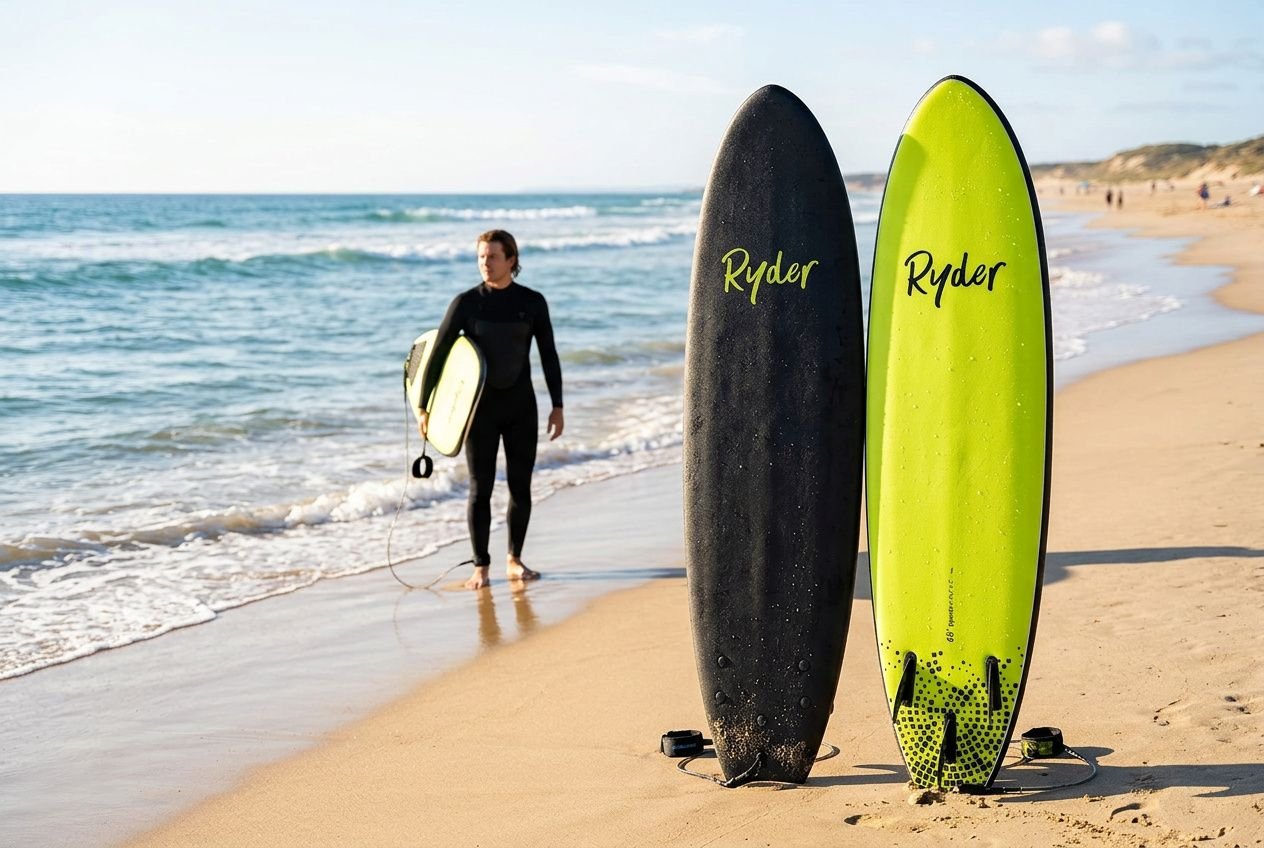
For learning to surf, every surfboard currently on sale falls broadly into two groups: foam soft-tops and hard boards. For most complete beginners, the soft-top is the practical choice. Its foam deck cushions falls, soft safety fins reduce the risk of cuts, and the high volume of a typical softboard shape provides flotation without making you fight the board. A quality foamie also costs less than an equivalent epoxy hard board at the same volume.
More confidence gives you more attempts, which means more waves caught and more time practising standing up, trimming and reading the break. Hard boards offer less forgiveness and slower early progression; by contrast, they suit experienced surfers chasing performance, but they suit you less if you are still building basic surf technique and water confidence.
Durable construction for regular surf sessions
Not every foam board is built to the same standard. Construction quality separates a board that lasts for years from one that develops flex and structural weakness within months. The NSP P2 Soft Surf Wide is designed for regular use: it has an EPS core reinforced by two fibreglass stringers in a T-shape, a fibreglass-and-epoxy outer shell and a PE slick bottom. In practice, this means fewer pressure dents and a more stable flex pattern session after session.
- EPS core with T-stringers Two fibreglass stringers in a T-arrangement limit flex through the nose and tail. Your paddle strokes and pop-up timing stay more consistent from one session to the next.
- Epoxy lamination Two fibreglass layers on the deck and one on the bottom, laminated with epoxy resin, form a shell that resists pressure dents and impacts better than basic foam construction.
- EVA foam deck The deck removes the need for wax, reducing preparation before you surf while keeping the surface soft and grippy throughout its service life.
- Rubber bumpers and handles Rubber bumpers on the nose and tail help protect against collision damage. Integrated handles at the nose, centre and tail also make a large board easier to carry across the beach by yourself.
With that structure in place, the NSP P2 Soft Surf Wide works as a school-grade learning tool rather than a basic starter board. Flexible fins come supplied, which keeps your setup simple before your first session. Mundo-Surf stocks this model with verified availability from its own warehouse: the board you order is physically present rather than subject to uncertain lead times.
What to check before buying
Before you buy, check the internal stringer arrangement: it is the key structural feature often missing from budget foam boards. Without sufficient reinforcement, a board flexes through the tail during every paddle stroke, making consistent technique difficult to develop. Check for a rigid tail block and a reliable fin system, whatever the advertised price.
Fin quality is the next checkpoint. Floppy plastic fins can flex unpredictably under your feet, making it harder to hold a wave line and reducing the board's drive through the water. The NSP P2 Soft Surf Wide includes flexible safety fins that stay secure in their boxes, bend safely on impact and provide enough stiffness for directional hold. That balance suits a learning environment: soft enough to reduce injury risk, yet rigid enough to work properly.
You need a correctly sized leash, a wetsuit suited to UK water temperatures and surfboard wax for any hard-top board you use as you progress. Even with a non-waxed EVA deck, the leash remains essential: it keeps your board close after a wipeout and stops it becoming a hazard to other surfers. Mundo-Surf offers 100-day returns and free shipping on orders over £99, including accessories bought alongside the board.
From soft surf sessions to progression
Once you can paddle efficiently, pop up under control and ride along the wave face instead of travelling only through whitewater, it is time to consider what comes next. Moving from a soft learning board to a more responsive shape is not about abandoning volume. It is about choosing a surfboard that rewards the technique you have built while adding enough responsiveness to keep your progression moving.
Timing matters. Move too early and you lose the forgiving stability that helped you learn; move at the right point and the new board becomes a useful step forward.
A surfboard shape for small waves
The ideal beginner shape combines a relatively flat rocker with enough nose lift to prevent frequent pearling. A flatter rocker creates speed in small, weak surf and carries that momentum through the paddle phase, which helps a new surfer with catching waves in ankle-to-waist-high conditions. Too much rocker reduces paddle efficiency, while too little sends the nose underwater.
A balanced rocker sits between those extremes and suits a broad range of learning situations without demanding precise wave selection. The Zeus Fuego 7ft uses a soft-top surfboard configuration designed for learning to surf, with 56-litre volume and an EVA deck suited to lighter adult beginners who want to start riding waves with minimal friction.
Surfworx guide to fins and rails
The Surfworx guide to choosing fins and rails for a first board is simple: prioritise predictability over performance. Rail shape and fin configuration work together to determine how the board feels underfoot, so both should support a stable platform while your technique is still developing.
- Thruster setup Three fins of equal size create a balanced, drive-forward feel and remain common on beginner foam boards. All three fins must be present and securely fitted before you enter the water.
- 2+1 setup One larger centre fin and two smaller side fins provide straightforward tracking with manageable turning resistance. This is a reliable stable platform for riders developing directional control and weight distribution.
- 60/40 rails Curvature above the rail centre, combined with a flatter lower section, creates a forgiving feel along the full length of the board. It supports balance development without the unpredictable release of a harder, sharper rail.
- Tail shape Rounded-pin and bump-squash tails are both common on beginner boards. Neither offers a meaningful advantage at this stage; width and volume remain the deciding factors for learning performance.
That fin and rail setup works best when the outline supports it. A broad nose and tail keep the board forgiving during the pop-up and while trimming along the wave face. Narrower designs improve agility once the basics are secure, but they make balance and body awareness harder for a beginner who is still building repeatable technique in varied surf.
With the main board features checked, look at the leash length. It should match the board's length: a 7ft board requires approximately a 7ft leash, while a longer board needs a proportionally longer cord. An undersized leash on a larger board creates extra tension during wipeouts and can pull the board back unpredictably. Check the complete equipment setup from the start—board, fins, leash and wetsuit—so avoidable obstacles do not get in the way of your first sessions.
Moving beyond a soft board
The right moment to leave a softboard is clear. You should paddle without excessive fatigue, pop up with consistent timing and foot placement, and trim along the wave face instead of riding only in a straight line through whitewater. Before all three points are in place, changing to a harder board usually interrupts progress. Once they are established, an epoxy board is a natural next step: lighter, more ding-resistant than traditional polyester construction and more responsive without giving up too much of the float you have relied on.
A mini-mal or round-nosed board between 7ft 2in and 8ft 6in is a common progression route. It retains wave-catching ability and enough length to keep your session count high, while its harder rails and more refined shape help you begin linking turns and reading the wave face with greater intention.
The same logic applies to volume. Keep enough float to catch waves consistently, then reduce it gradually rather than jumping straight to a shortboard. Mundo-Surf's learning surfboard guide explains this transition in detail, including how to match your next board to your current ability level. Read the learning surfboard guide before making that next purchase.
Frequently Asked Questions
For most new surfers, the right surfboard starts with matching your body weight to its length and volume. Adults under 70kg can begin with a soft-top surfboard for learning to surf, such as the Zeus Fuego 7ft, which offers 56 litres of volume and needs no wax because of its EVA deck. Adults between 75kg and 85kg should step up to a board in the 7ft 6in to 8ft range with at least 60 litres. A Wave Bandit or another school-grade softboard also suits riders who expect heavy, repeated use.
Whichever model you choose, look for a width of at least 22 inches, between 2 and 2.5 litres of volume per kilogram of body weight, an EPS core with proper internal stringers and flexible safety fins.
A longboard, typically 8ft or longer, gives you strong stability, generous volume and easy paddling. That makes it a sensible starting point for many adult beginners, especially heavier riders or anyone who prefers a relaxed, flowing style of surfing. Its extra length helps the board catch a wave earlier and gives you more time to complete the pop-up before the wave passes.
By contrast, a traditional longboard with 50/50 rails and little rocker can be awkward on steeper beach breaks. Your rocker still needs to suit the local wave type. For UK surf spots, which are often punchy rather than long and mellow, a high-volume foam board between 7ft 6in and 8ft 6in usually offers a better balance of stability and manoeuvrability than a full longboard for a complete beginner.
Move from a foam learning board to a harder epoxy or polyester board when your skills show that you are ready, rather than after a fixed number of sessions or weeks. Your paddling should be efficient, without leaving you fatigued after a short set, and you should read and position yourself for each wave without constant adjustment. Your pop-up also needs to be consistent in its timing and foot placement across different wave sizes and types.
The final marker is control on the wave face: you can trim with intent instead of riding straight towards the beach every time. Once these skills are established, consider the NSP P2 Soft Surf Wide for learning as a durable intermediate step. Its epoxy-reinforced construction bridges the gap before you commit fully to a hard board. Keep enough size for a healthy wave count; dropping too much volume too quickly is a common mistake at this stage.
Share this article: