Shopping Cart
There are no more items in your cart


12 Week surf training program to boost your surf fitness


This article maps out a full 12-week surf training program in three progressive phases, helping you build the paddling strength, pop-up power, balance and cardiovascular endurance needed before your next surf trip. Whether you are preparing for your first session or aiming for more committed surfing, each section gives you practical exercises, weekly scheduling guidance and equipment choices.
Build your 12-week surf training program
A structured surf training plan works because it targets the physical demands surfing places on your body: repeated paddle efforts, explosive pop-ups and board control against wave force. Before you start, check out the beginner softboard guide if you are still choosing a surfboard. Mundo-Surf stocks equipment for every stage of progression. For fins, the versatile quad rear surfboard fins from the MS-1 Corelite range are 25% lighter than fibreglass fins, making them a practical upgrade as your board control improves. Sort your leash early as well: the orange Mundo-Surf surf leash has a double swivel and key pocket, with solid durability at a competitive price.

Phase one surf foundations
The first four weeks of a 12-week surf training program establish the base you need before intensity rises. Phase one introduces fluid mobility drills, low-to-moderate cardio for aerobic endurance and dynamic-strength movements that reflect the four core surfing demands: paddling, pop-ups, board control and rapid cardiovascular recovery. Technique and posture come before load.
- Mobility drills Controlled articular rotations target the shoulders, hips and thoracic spine, restoring joint range that sedentary habits can reduce before paddling demands increase.
- Aerobic cardio Steady freestyle swimming develops the pulling endurance your lats and arms need to sustain five-to-ten-minute paddle efforts without fading.
- Dynamic strength Flying superman holds train the spinal extensors that maintain the prone paddling position, helping limit early fatigue on the board.
In practice, wave count is the simplest way to monitor phase one progress. If you are surfing alongside the programme, you should notice fewer rest stops during paddle-outs by week four. Keep repetitions towards the lower end of the six-to-twelve range and rest fully between sets, prioritising posture and range of motion over load. That control carries directly into the water.
| Week | Focus | Key exercise | Session type |
| 1–2 | Joint mobility and posture | Controlled articular rotations | Low intensity, technique |
| 3 | Paddling endurance base | Freestyle swimming | Steady-state cardio |
| 4 | Dynamic strength introduction | Flying superman holds | Bodyweight, controlled pace |
Phase two strength and mobility
Phase two raises the workload. Cardio intensity increases, surf movement strength becomes the main target, and flexibility work bridges the gap between gym capacity and on-water demands. For beginners following a 12-week surf training program, compound lifts such as front squats, Bulgarian split squats and suspension-trainer rows begin to translate into longer, more controlled rides. Build on the mobility and posture developed in phase one instead of dropping them for heavier loading. Joint quality still drives performance.
Phase three power and recovery
Phase three shifts towards dynamic movement and surf power, using professional-level conditioning concepts scaled to your training history. Box jumps, rotational jumps and burpee Tabata intervals develop the explosive capacity needed to pop up after a hard paddle. The right choice when progressing these drills is a load and pace that let you produce force quickly without losing control while fatigued, as catching a steep wave demands.
Building on that power work, phase three also includes structured breath work and paddling endurance sessions to improve cardiovascular recovery. Shorter rest periods between sets teach your system to settle quickly, giving you more usable surfing time in each session. By week twelve, the combined effect of all three phases should be a measurable increase in wave count and fewer breathless recovery pauses. That is the point of a well-built surf training plan: every movement supports the next one.
Weekly surf fitness schedule
Knowing the three phases is only half the answer. You also need a weekly schedule your body can absorb without accumulating fatigue or developing overuse injuries. A well-structured surf fitness week creates enough stimulus for adaptation while preserving the recovery that makes those gains stick. That balance separates an effective plan from one that simply exhausts you.
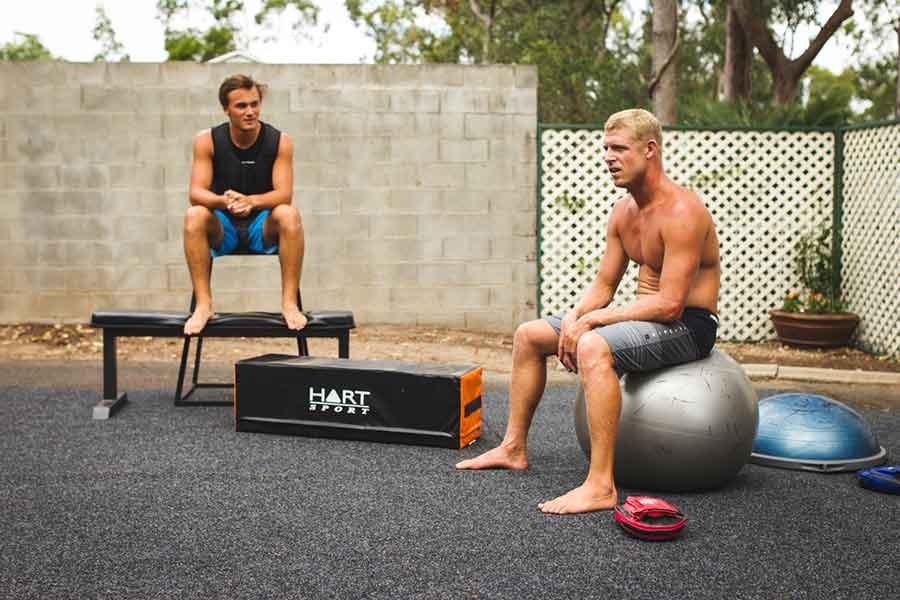
Two to three sessions weekly
The right structure for this surf training program, two to three full-body sessions each week, spaced evenly so you avoid consecutive training days during the early phases. That frequency can improve paddling endurance and strength without overloading your recovery capacity.
- Session order Begin with your most demanding movements, such as muscle-ups or clean and presses, while your nervous system is fresh and your technique remains sharp.
- Rep and set targets Complete three to five sets of six to twelve repetitions per exercise, with sixty to ninety seconds of rest between sets for most strength work.
- Cardio finisher Finish with a short cardio smoker: a Tabata interval lasting under five minutes, or one hundred kettlebell swings, to train effort and recovery while fatigued.
- Supplemental shoulder work Add targeted pulling exercises for the shoulders on lighter days, because paddling places sustained demand on the rotator cuff and surrounding muscles.
On the water, that matters: the cardio smoker at the end of a gym session resembles the effort of catching a wave after an extended paddle-out. Training that pattern on land makes it more familiar in the water. Prioritise posture and control in every repetition instead of chasing maximum load, because technique breakdown under fatigue is where surf-related shoulder injuries begin.
Core and prehab work should close every session. These movements help protect the joints that accumulate the most stress across twelve weeks of surf-specific training, particularly the shoulders, lower back and knees. Ending with core stabilisation rather than another heavy set keeps you training consistently.
Choose the right workout level
Choose between two structured full-body options according to your current capacity. You can access a 12-week surf training program, free of charge, through bodyweight and suspension-trainer movements if your equipment is limited, or progress to the higher-intensity version with full muscle-ups and slow, controlled clean and presses once your strength base supports it. The right choice when starting is the one that lets you maintain clean form across all four sets.
By contrast, the high-intensity version uses the same movement patterns but requires greater neuromuscular coordination and strength. Full muscle-ups train the complete reach-and-pull arc of the paddle stroke, while slow, controlled clean and presses develop the latter part of the stroke, when the arm exits the water and reaches forwards. Both workouts finish with the same cardio smoker, so you get equal conditioning work regardless.
Use recovery to guide progression
Let recovery dictate progression. If your muscles are sore, skip one training day and replace it with mobility work rather than pushing through. That substitution preserves movement quality without adding load to tissue that needs repair, allowing better adaptation over twelve weeks.
Joint soreness sends a different signal. As soon as a joint feels irritated rather than simply worked, take two full days away from loading and focus on mobility and gentle range-of-motion work. Ignoring that warning is a common way for a twelve-week programme to become six weeks of training followed by eight weeks of rest. The same logic applies to your shoulders throughout this plan because paddling places substantial demand on them.
Once you can complete all prescribed sets with clean form and recover fully within forty-eight hours, you have a clear indication that you are ready to increase difficulty or load the following week. Progression without that signal only accumulates fatigue. Build on the previous week rather than moving to the next phase simply because the calendar says so.
Movement patterns for stronger surfing
Surf-specific training is built around six foundational movement patterns: squats, lunges, bends, rotations, pushes and pulls. Every exercise in this programme links to at least one of them.

Paddling strength and shoulder control
Mastering beginner surfing techniques on land before entering the water means breaking the paddling action into three phases: the reach, the pull and the exit. Each phase uses different muscles and places distinct demands on shoulder stability. Neglect one phase and fatigue will expose the weak link within minutes.
- Suspension trainer muscle-ups These mimic the reach-and-pull arc of paddling, training the lats, chest and shoulders through the full pulling pattern.
- Clean and presses These train the exit phase, when the arm leaves the water and sweeps forwards, developing the posterior shoulder and triceps for a more efficient stroke.
- Flying superman This replicates the prone position on a surfboard and strengthens the spinal extensors needed to maintain it during extended paddle efforts.
Building on that pulling foundation, freestyle swimming remains one of the most transferable cross-training options. It engages the upper and lower back, arms and core through a similar pulling motion to the one used on a surfboard, while also developing cardiovascular endurance that gym work alone cannot fully replicate. Even two short pool sessions per week across the twelve weeks can add measurable paddle capacity.
Extra shoulder drills are worth adding throughout the programme because paddling places sustained, repetitive demand on the rotator cuff. Push-ups belong here too: they strengthen the arms, shoulders, upper back and chest while supporting spinal alignment and core stability, making pop-ups and duck dives more efficient. Treat them as primary movements in the earlier phases, not merely as warm-up work.
Pop-up drills for surf readiness
The pop-up requires less absolute strength than many surfers expect, but it demands stamina because it comes immediately after the hardest part of a paddle effort. Burpees are the right choice when you train this demand. The movement closely mirrors rising from a prone position into a standing surf stance. Performed as Tabata intervals, they build full-body strength and cardio conditioning at the same time.
Twisting burpees extend that benefit by adding rotation, challenging balance during the transition from prone to standing, where many beginner pop-ups fail. Dynamic lunges complement them by developing hip and leg stability for the same movement.
Board control through strength
Controlling a surfboard through a duck dive or turtle roll requires grip strength to hold the board against wave force, along with the pushing and pulling strength to redirect it cleanly. Push-up rows address all three qualities: the push-up trains pressing strength and core stability, while the row develops the pulling and grip strength needed to anchor the board against oncoming whitewater.
Squats reinforce board control from below, building the leg and spinal strength needed to crouch, adjust and turn without losing position. Single-foot planks add core demand through instability, which is closer to the body’s experience on a moving board than a standard bilateral plank.
Balance and endurance for every surf
Strength alone will not make you a better surfer. Balance and endurance matter just as much in a complete pre-surf preparation routine, and each quality needs focused work rather than being treated as a by-product of strength training. Across twelve weeks, combining strength, balance and endurance produces a noticeably different result on the water from a programme that prioritises only one.
Single-leg balance for surfing
Single-leg exercises such as lunges and Bulgarian split squats develop leg strength and balance together, so they are more time-efficient than standing on a wobble board alone. You can often find a reliable 12-week surf training program as a free PDF download to use as a starting point, but a plan that separates balance from strength misses the efficiency of these compound movements. Combine both qualities from the outset.
- Bulgarian split squats Build unilateral leg strength and hip stability, supporting the asymmetric stances that surfing constantly demands.
- Dynamic lunges Improve the hip and leg coordination required to move from lying prone on the board to standing, which is especially valuable for newer surfers learning this movement pattern.
- Balance board progressions Start by finding centre balance while standing, then bend the knees towards each edge before progressing to a jumping 180-degree turn as your board feel develops.
- Twisting burpees Combine a push-up, jump and rotation, challenging balance during the explosive transition from prone to standing and closely replicating the demands of a pop-up on a wave.
Building on that single-leg work, yoga completes the balance and flexibility element in ways gym exercises cannot fully reproduce. Five poses are particularly useful for surfers: downward-facing dog, pigeon, eagle, boat and upward-facing dog. Together, they target the hips, thoracic spine and shoulders while restoring range of motion reduced by heavy paddling and prolonged prone positioning. Two short yoga sessions per week across the programme can also support joint health.
Mobility before and after surf
Controlled articular rotations, or CARs, take each joint gently towards the outer limits of its usable range. They are a precise mobility tool for surfers, helping restore flexibility affected by sedentary habits or ageing without loading unprepared tissue. Use them at the start of each session before strength work, then repeat them after surfing to manage cumulative joint stress.
Phase one prioritises mobility because joints that cannot move freely through their full range make neighbouring structures compensate. For example, a shoulder lacking internal rotation may recruit the neck and lower back to complete each paddle stroke. Addressing that restriction early gives every later training phase a stronger foundation for surf-specific demands.
Equipment choices for beginners
The right equipment removes unnecessary barriers from your first session. The NSP P2 Soft Surf Wide features an EPS core with dual fibreglass stringers, a fibreglass and epoxy outer layer, rubber bumpers at the nose and tail, and flexible fins. This construction is robust enough for repeated use while learning. Mundo-Surf stocks boards of this type for surfers who need a wide, forgiving shape that supports safe progression from scratch.
Once your board is sorted, fins and a leash matter more than many beginners expect. The Mundo-Surf MS-1 Corelite quad rear fins use RTM technology with Dual Hex foam, making them 25% lighter than fibreglass fins while retaining progressive flex for increased speed. Pair them with a Mundo-Surf Basic Leash, which has a double-swivel construction and key pocket, and your surf workout plan setup is reliable enough to last the twelve weeks without replacement.
Frequently asked questions
What is a good surf workout plan to follow three times a week?
A practical surf workout plan uses two to three full-body sessions each week, built around six foundational surf movement patterns: squats, lunges, bends, rotations, pushes and pulls. Complete three to five sets of six to twelve repetitions per exercise, then finish with a short cardio interval, such as a Tabata lasting under five minutes. Close with core and shoulder prehabilitation work.
Space the sessions evenly across the week. In practice, recovery signals help you decide when to add load: muscle soreness may be manageable, while joint soreness calls for a mobility day or a substituted exercise.
Are surfing training programs suitable for people with no gym access?
Yes. Surfing training programs based on bodyweight and suspension-trainer movements work well at home or outdoors. Many surf-specific exercises, including push-ups, flying superman holds, dynamic lunges, single-foot planks and burpees, require no equipment.
A balance board and resistance bands widen your options without requiring a full gym. The low-intensity version of the full-body session in this programme is designed for that setting, using scalable movements to build genuine surf fitness without a commercial gym.
What makes a surf athlete training program different from general fitness training?
A surf athlete training program reflects the intermittent, high-intensity demands of surfing: hard bursts of paddling and pop-ups followed by short recovery periods, repeated throughout a session. General fitness training rarely reproduces that pattern.
Surf-specific training also places greater emphasis on shoulder durability, grip strength, rotational power and single-leg balance. Those qualities affect how long you can stay effective in the water and how cleanly you control the board. The twelve-week format develops them progressively rather than in isolation.
Share this article: