Shopping Cart
There are no more items in your cart


Bodyboard Manual: a beginner guide to bodyboarding


A bodyboard manual for beginners has to cover more than riding. You need a board sized to your weight, fins that stay put, a leash fitted correctly and a wetsuit for UK water. Then come the steps that matter in the sea: choosing a lifeguarded beach, paddling out, catching whitewater and handling a rip current if one takes you.
Choose a bodyboard that fits
A bodyboard is a short, flexible board ridden mostly lying face down. Size comes first, construction second. Both shape how easily you catch waves in your early sessions.

Check the length and flotation
Stand the board on its tail: the nose should reach somewhere between your upper hip and your navel. That check is rough, though. Your weight and the waves you plan to ride also count, and a wrong length shows up quickly in the water.
- Too long: the board pushes water and becomes harder to control.
- Too short: it lacks flotation, so catching waves takes more effort.
- Lighter adult: one UK size chart places riders of 66–82 kg on its 42-inch row.
- Heavier adult: the same chart places riders of 82–102 kg on its 44-inch row.
Treat any chart as a starting point, never a prescription. According to Mundo-Surf, lengths of 38, 39, 40, 41 and 42 inches cover many adult and junior riders, and the bodyboard range with size guidance lists each one.
| Rider weight | Suggested length (one UK chart) |
| 18–29 kg (child) | 32–34 inches |
| 66–82 kg | 42 inches |
| 82–102 kg | 44 inches |
Understand beginner board construction
Once the length is right, look at what the board is made of. Beginner boards usually pair a soft foam deck with a plastic underside. Their core is often expanded polystyrene (EPS): light and rigid.
Core choice also follows water temperature. Mundo-Surf notes that polyethylene (PE) flexes more progressively in cold water, while standard polypropylene (PP) is stiffer and can feel too rigid in a UK winter. Learn the parts too: the deck is the soft top, the slick the underside, the rails the side edges, and a stringer an internal reinforcing rod. When choosing, deck, slick and reinforcement quality all affect durability.
Size a board for a child
Children follow the same logic on a smaller scale, starting from the child row of the chart above.
A board that fits helps a child ride. It never replaces an adult's supervision or a proper look at the conditions.
Fit your fins, leash and wetsuit
With the board sorted, the rest of your equipment decides how long you stay comfortable and connected to it. Fins give you speed, the leash keeps the board close and the wetsuit holds off the cold.
Choose fins that stay comfortable
Bodyboard fins are shorter and more responsive than swimming or diving fins, according to Mundo-Surf. They add propulsion for catching waves and moving through the water. Fit comes first, then stiffness.
- Snug, not tight: the fin holds your foot without pinching your toes or slipping around it.
- Soft blades: they generally suit beginners by reducing ankle and calf fatigue.
- Asymmetrical shape: Mundo-Surf presents it as a common choice for a natural kicking motion.
Building on that, try fins on with any neoprene fin socks you will wear. Below 17°C, Mundo-Surf points out, those socks can improve warmth and reduce rubbing inside the fin.
Fin tethers reduce the chance of losing a fin in a fall or a sideways current. The bodyboard fins sorted by stiffness and size can be paired with them.
Attach and check the leash
A leash connects you to the board through a plug and helps you recover it after a fall. Mundo-Surf notes that a bicep attachment can leave more freedom for paddling than a wrist one.
Fitting the plug for a bodyboard leash needs care. Check where any stringers run first, because drilling through one can damage the board. Then position the plug for the arm that will wear the leash.
Methods vary by plug type, so follow that plug's own instructions. Swivels on some wrist and bicep bodyboard leashes reduce cord tangling, according to Mundo-Surf.
Dress for cold water and inspect your kit
A well-fitting wetsuit helps you keep warm and reduces rubbing against the board. On the water, that matters: the RNLI warns that water at 15°C or below can seriously affect breathing and movement. Wax on the deck can improve grip. Before entering, check the board for loose seams or cracks, the leash for damage and the fins for poor fit.
Choose a safe place for your first sessions
Good kit only helps in the right spot. Your first bodyboarding sessions depend on picking a beach where the waves, the lifeguards and the space around you all work in your favour.
Find gentle whitewater and clear space
Pick a lifeguarded beach with small, gently breaking waves. You want repeatable whitewater, not waves that dump onto the sand.
Same logic applies to obstacles: keep clear of rocks, groynes, piers, steep shorebreaks and other people. Before entering, locate an exit point and any nearby hazards.
Read the beach flags
Flags tell you where you may ride. Check them as soon as you reach the sand.
- Red and yellow: the lifeguarded area where swimmers and bodyboarders should stay.
- Black-and-white chequered: a zone for surfboards and other watercraft, not for swimming or bodyboarding.
- Red: do not enter the water, according to the RNLI.
- No flags: the beach has no marked lifeguarded zone, so pick another for your first sessions.
Keep checking where they stand while you ride.
Check changing conditions before entering
Compare tide, wind and swell forecasts with the sea in front of you. An offshore forecast does not guarantee wave size at the beach. Ask the lifeguards about the day's conditions and local rip currents.
The tide deserves its own check. According to the Met Office, a rising tide can make water much deeper and cut off a route back to safety. In England, the Environment Agency's Swimfo service gives bathing-water site information and, at some sites, daily pollution-risk forecasts during the May–September season; an annual classification is not a live reading.
For a child's first sessions, keep an adult nearby. Stay in shallow whitewater within the flags and plan short sessions with breaks.
Enter the water and catch your first waves
In the water, kit turns into technique. You start in shallow water, learn to move on the board and then ride broken waves straight to shore.
Enter, paddle and move out
Begin in manageable shallow water, holding the board in front of you so it cannot strike anyone. Practise on waves that have already broken before going beyond them. To move out, centre your weight, grip near the front and kick with your feet under water for traction; arm paddling also works.
In practice, paddling farther out comes only once you control the board in whitewater. Wait for a lull between wave sets, keep checking your position against the flags and avoid exhausting yourself.
Position yourself and catch whitewater
For a first ride, pick broken whitewater travelling towards shore. Face the beach and leave clear space ahead.
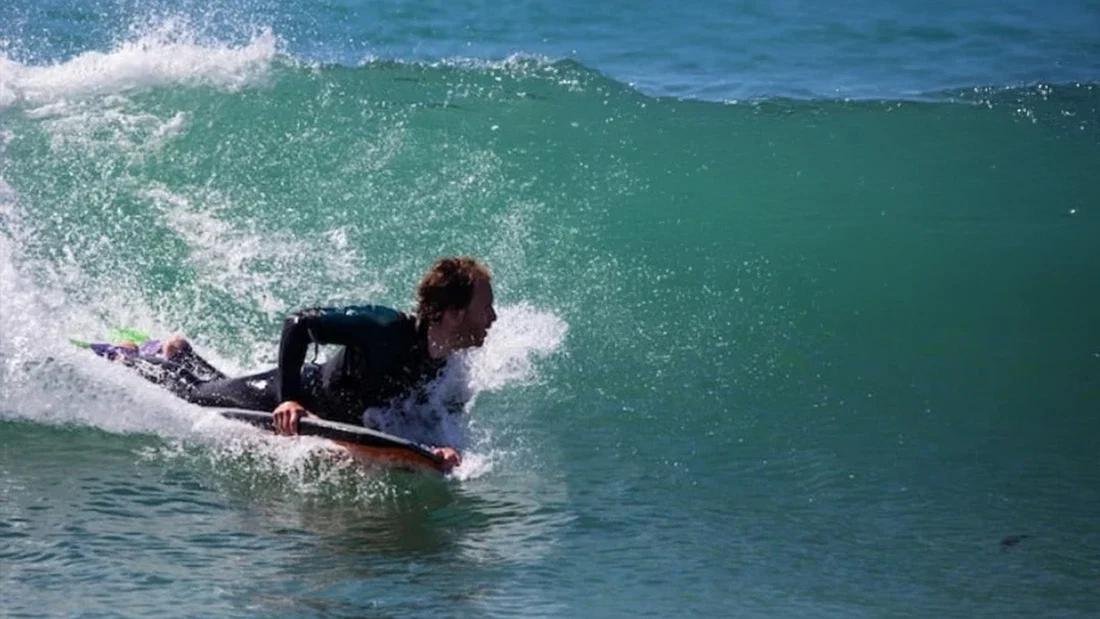
Your stance is prone and centred: head up, nose skimming just above the surface, neither buried nor raised high. As the wave approaches, kick with your feet in the water; an arm can paddle until the board accelerates. That acceleration is the sign you are catching waves.
Ride straight and finish safely
Once the wave carries you, stop paddling and hold the board firmly with both hands. Ride straight towards shore, looking ahead. If the nose buries, shift slightly back; if the wave passes beneath you, move slightly forward or start kicking earlier.
Finish before the water gets too shallow. Keep hold of the board and move clear of the next rider.
Respond to rip currents and emergencies
Even within the flags, the ocean can move you where you do not want to go. Knowing how a rip behaves and what to do inside one is part of your safety kit.
Understand the risk of a rip
Rip currents can carry a bodyboarder away from the shallows and may reach 4–5 mph, according to the RNLI.
Your kit does not change that. The difference comes down to your response, not your equipment.
- Leash: it keeps the board close but does not make a rip safe.
- Fins: extra propulsion is no protection against a rip either.
- Board: hold onto it while you signal.
The RNLI recorded 13 lifeboat launches to bodyboarders and 1,249 lifeguard assists to people on bodyboards in 2024. Those totals do not predict any individual rider's risk.
Keep afloat and work towards safety
Caught in a rip, avoid exhausting yourself swimming straight against it. Hold the board, raise an arm and shout for help.
Then use what the water allows. If you can stand, wade, the RNLI advises. If you can swim, move parallel to the shore until clear of the rip, then use the wave energy to return.
Signal for help and leave the water
If you cannot make progress, the RNLI advises floating and signalling continuously. In a UK coastal emergency, alert a lifeguard or call 999 or 112 and ask for the Coastguard.
Never put yourself in danger by attempting a water rescue. Leave the water before cold or fatigue makes your own return difficult.
Recommended products

Frequently Asked Questions
A duck dive sinks the board beneath an approaching wave so it passes over you. Over shallow reefs, it becomes a strike hazard.
No. Beginner boards usually combine a soft foam deck, a plastic underside and a light, rigid EPS core, which is enough to learn on.
Agree where and when you will both leave the water before you go in.
Share this article: