Shopping Cart
There are no more items in your cart


Bodyboard positioning in waves: a beginner's guide


Getting your bodyboard positioning in waves right comes down to three things: where your body sits on the board, how your hands hold it and where you wait for the swell. Small corrections to each one help you catch waves and keep a controlled line.
Position your body on the bodyboard
A bodyboard is a short, flexible board that you ride lying down. Before anything else, three parts need names: the nose is the front, the tail is the rear and the rails are the long side edges.
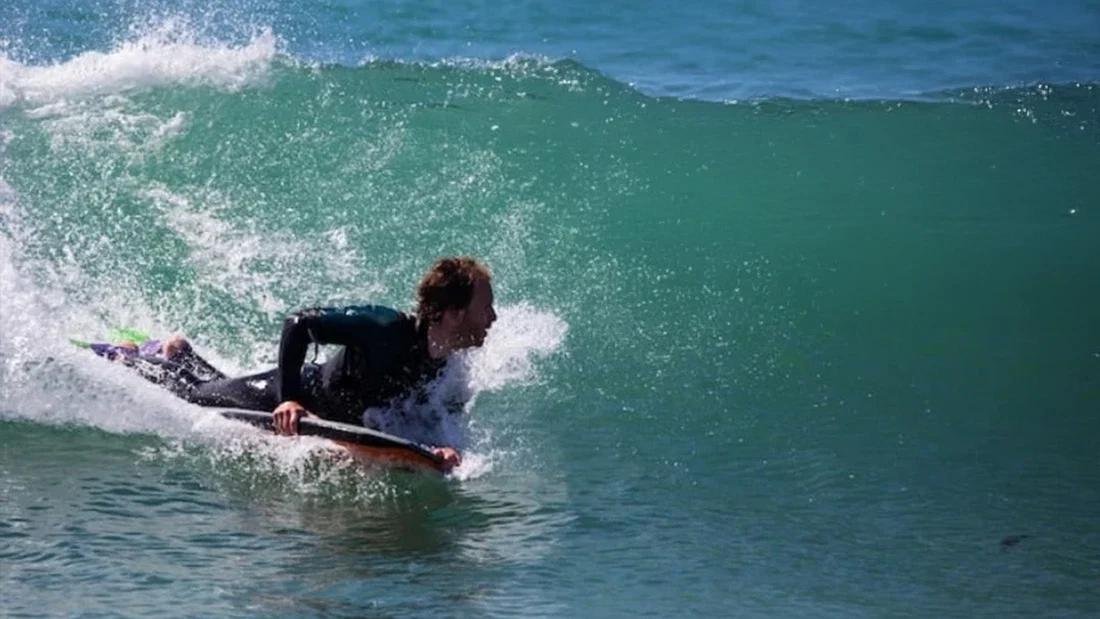
Set a stable prone position
Start by lying along the centre line of the board. From there, three reference points build your placement:
- Hips rest on the board towards the tail.
- Chest and upper torso sit roughly over the front third.
- Head lifts just enough for you to see ahead.
The front third is a starting point, not a fixed rule. Each board and each rider is different, so move a little until the board feels settled under you.
Adjust nose height and trim
Once you are settled, check the nose: it should sit just above the water. If it goes under, move back slightly. If it rises too high, move forwards slightly. A gently arched back with your chest raised lets you look ahead without pushing the nose down.
Building on that, keep your hips on the board and your legs free to kick, not dragging deep in the water. That balance is called trim: a body position and direction that keep up a useful glide. In practice, a small shift forwards can add speed, while moving back puts more of your legs in the water and adds drag.
Check whether the board fits
Even good trim depends on the right board. Mundo-Surf uses a board reaching roughly your navel as a size guide and advises beginners to look at one that extends 2–5 cm above it. Your weight and skill level also count, as the bodyboard range and its sizing guide explains.
Getting the size wrong works against your position. A board that is too small can sink early. One that is too large gives stability but responds less to your weight shifts.
Hold the board to ride across a wave
With your body in place, your hands decide where the board goes. Grip, elbow position and rail pressure turn a straight run to shore into a line along the wave face, but that line comes after you can control a simple ride.
Begin with a controlled straight ride
As a beginner, start on small broken waves and ride straight towards shore before trying to cross an unbroken face. Each straight ride follows the same sequence:
- Catch a manageable broken wave.
- Settle into a stable prone position once the board is carrying you.
- Look towards where you want to go, not down at the nose.
- Hold that line all the way to shore.
Once these rides feel repeatable, your eyes are already leading the board. That habit is what directional riding is built on.
Place your hands for a directional ride
For a directional ride, grip the front corner with your leading hand: generally the left when travelling left, the right when travelling right. Your rear hand holds the opposite rail, roughly level with your hip.
Rest your leading elbow on the board, with that arm bent at about 90°. The two-hand grip gives you leverage to lift the nose and engage a rail. On the water, that matters, because steering comes from that leverage, not from muscling the board around.
Angle across the face with rail pressure
Once your grip is set, look along the line you want and press gently on the inside rail with your elbow and body weight. The fin on that side can also help steer. To change direction, adjust weight and hand pressure in small amounts and lift the opposite side where needed, rather than throwing your shoulders around.
Timing your angle matters just as much in bodyboarding. Angling too far across before you have built speed can spoil the catch. Pointing too far down the face can lose the line you wanted.
Position yourself to catch the swell
Riding across a face starts before the wave reaches you. Good positioning, the right kick and correct weight at the moment of lift decide whether the swell picks you up or rolls past.
Choose a safe take-off spot
On an unbroken wave, wait in front of the area where it starts to break, rather than chasing it once it has turned to white water. Practise in small conditions between the red-and-yellow flags at a lifeguarded beach; the RNLI also advises checking conditions and wearing a leash. Mundo-Surf advises always using one and choosing between wrist and biceps bodyboard leashes according to personal preference. If a rip current takes you, stay with the board if you can, move parallel to shore if able and signal for help instead of swimming against it. The RNLI says rips typically move at 1–2 mph, and some reach 4–5 mph.
Build speed with strokes and fins
From that spot, face the shore. As the wave approaches from behind, start arm strokes and fin kicks so you are already moving before it reaches the tail of your board.
Kick alternately from the hips with short, purposeful strokes and fairly relaxed knees. Big, bicycle-like or very deep kicks waste energy. Bodyboard fins give you short bursts of acceleration for catching waves and help you reach the take-off spot.
That acceleration only works if the fins stay on comfortably. Choose a pair that holds your foot securely without squeezing or rubbing. Mundo-Surf generally recommends soft or medium-soft bodyboard fins for beginners and occasional riders.
Let the swell carry you
As the wave lifts the board, kick harder. The timing of your last stroke and kick depends on the wave and your speed, not on a fixed count. At the same moment, shift forwards just enough to help the board accelerate without driving the nose under.
You have caught the wave when the board accelerates with it, rather than just bobbing as it passes underneath. From then on, focus on direction and trim instead of kicking hard.
Correct missed catches and unstable rides
Even with good positioning, some attempts go wrong. Each symptom below points to likely causes and a first adjustment to try. Treat them as starting tests: timing, wave steepness, board shape and rider experience can produce similar results.
When the swell passes underneath
A wave that rolls under you without lifting the board usually has one of three likely causes:
- Late start: you began kicking too late.
- Low speed: you were not moving fast enough at the lift.
- Tail-heavy weight: too much of you sat over the rear.
- Next attempt: start earlier, then test a slight forward shift of your torso.
The forward shift only applies if the board still feels bogged down after an earlier start. Change one thing at a time, so you can tell which adjustment made the difference.
When the nose dives or rises
If the nose plunges as the board lifts, too much weight forward or a steep wave may be the cause. Test a small move back and a slight lift of the nose.
The opposite fault calls for the opposite move. If the nose rises and the board ploughs or stalls, move forwards slightly. If the problem persists, check whether the board's buoyancy suits you.
When the glide slows or slips sideways
If the board catches the wave but slows almost at once, check for legs dragging in the water, too little momentum or a poor line. Only after that, try a small forward adjustment.
A different fault is running straight to shore when you meant to cross the face. Look along the route you want and practise engaging the inside rail, as described above.
If the board slides or rolls sideways, centre your torso. Then correct with smaller, more consistent pressure on the rails.
Recommended products

Frequently Asked Questions
One beginner guide recommends lifting your fins clear of the water during the glide, because fins left dragging slow the board. Once the wave is carrying you, focus on direction and trim rather than kicking hard.
Yes. Moving your arms forwards also moves your chest and lower torso forwards, which changes how your weight is spread across the board.
Stiff fins are the right choice when you have good technique and trained legs: Mundo-Surf notes they give maximum response but put more strain on ankles and calves. Medium-stiff fins combine propulsion, control and forgiveness across many levels and conditions, while soft fins give a less explosive response but reduce fatigue.
Share this article: